The TACIT Method™ — Definition & Scope
By Alexandro Bosschaerts | Bosschaerts Study

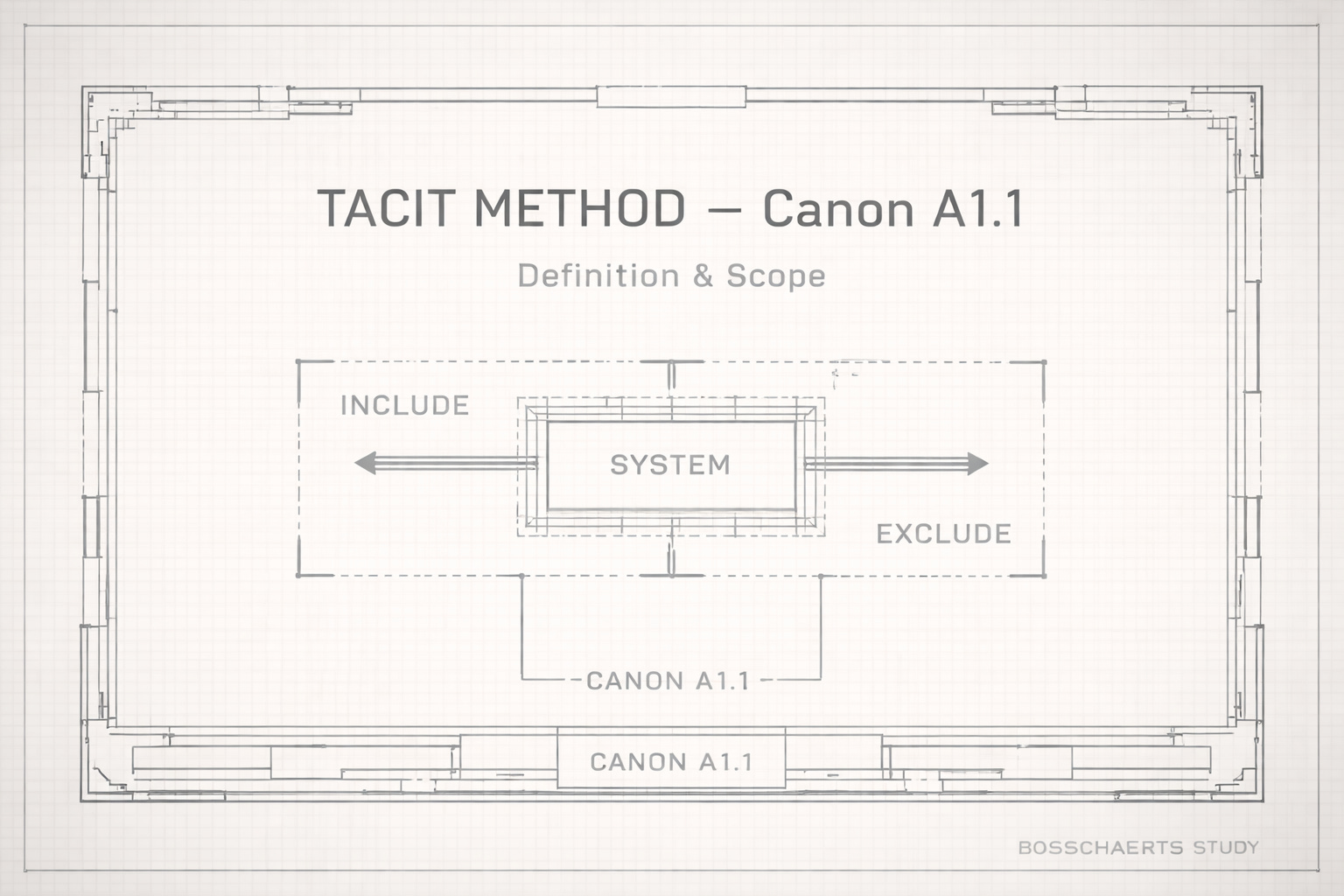
CANON A1.1
Definition
TACIT is a five-axis interpretive method for reading the second conversation in human interaction—the layer of meaning carried not by words alone, but by delivery, roles, setting, mismatch, and momentum.
TACIT is not about guessing intent. It is about structuring attention so that what is implied, avoided, delayed, or contradicted becomes observable, trackable, comparable, and testable.
TACIT =
Tone
Archetype
Context
Incongruence
Trajectory
Together, these five axes form a disciplined lens for interpreting human interaction without collapsing interpretation into certainty.
Boundary Notice (FIN)
TACIT operates under FIN (Formal Interpretation Nullifier), a canon-level constraint layer that governs when interpretation is permitted, when it must narrow, and when it must yield into silence.
TACIT does not produce decisions, diagnoses, or authority claims. Where certainty would outrun evidence, consent, or accountability, the system yields or remains silent.
Maps logic, not reality.
What TACIT Is
TACIT is:
a method, not a product
a lens, not a verdict
a discipline of observation, not mind-reading
a way to convert intuition into structured signals and questions
TACIT does not claim to reveal truth. It helps you notice where meaning is leaking, where patterns are forming, and where things may be heading if nothing changes.
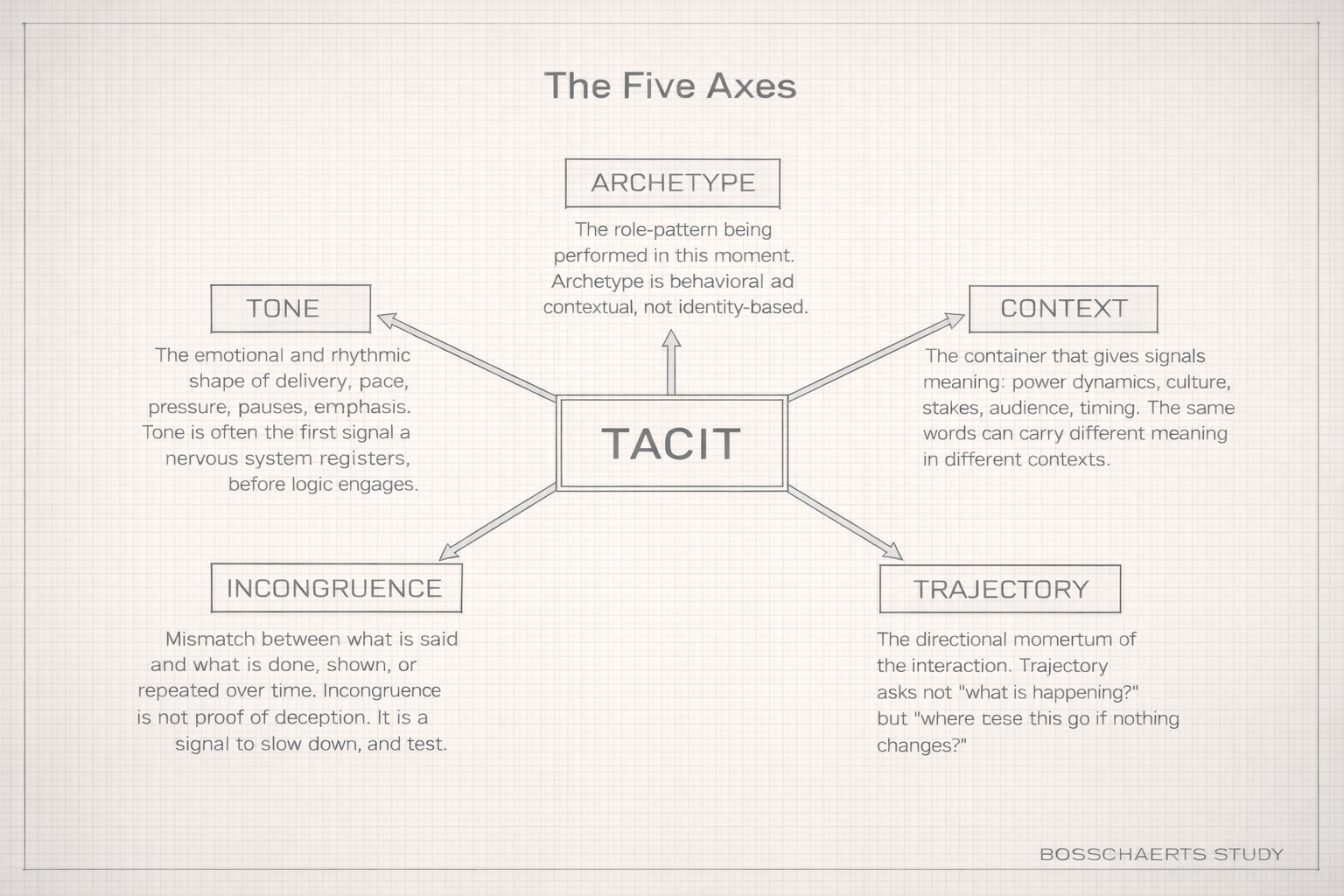
The Five Axes
Tone
The emotional and rhythmic shape of delivery: pace, pressure, pauses, emphasis. Tone is often the first signal a nervous system registers, before logic engages.
Archetype
The role-pattern being performed in this moment. Archetype is behavioral and contextual, not identity-based.
Context
The container that gives signals meaning: power dynamics, culture, stakes, audience, timing. The same words can carry different meaning in different contexts.
Incongruence
Mismatch between what is said and what is done, shown, or repeated over time. Incongruence is not proof of deception. It is a signal to slow down, document, and test.
Trajectory
The directional momentum of the interaction. Trajectory asks not “what is happening?” but “where does this go if nothing changes?”
What TACIT Produces
A valid TACIT read produces outputs, not conclusions:
observed signals (what was seen or heard)
labeled inferences (what might be happening, with uncertainty noted)
what is missing (information required to proceed responsibly)
options (questions to ask, tests to run, boundaries to set)
TACIT outputs warnings, questions, and choices—never commands.
Explicit Non-Claims
TACIT does not:
validate truth or reality
diagnose internal states
predict behavior or outcomes
produce decisions, recommendations, or action directives
certify safety or compliance
transfer responsibility from the human operator
Any reading of TACIT as evidence, diagnosis, or decision output is non-compliant.
Output Constraint
All TACIT outputs are non-actionable interpretive artifacts. They may be used for reflection and review only, and must not be used as justification for decisions, evaluations, or punitive actions.
Scope of Use
TACIT applies in environments where meaning is partially unspoken or distorted by power, emotion, or risk, including:
negotiation, sales, partnerships, hiring
leadership, collaboration, conflict repair
intimacy, dating, family dynamics (with restraint)
cross-cultural communication
self-regulation under pressure
TACIT may be used by individuals or teams, informally or systematically, with or without technology.
Downstream Effects and Responsibility
Human conversations do not end at the moment they occur. They propagate into systems, institutions, records, decisions, and communities.
Because of this, misreadings at the conversational level can accumulate into structural consequences—sometimes long after the original interaction has passed.
TACIT acknowledges this reality without claiming authority over it.
The method does not govern institutions, adjudicate disputes, or determine outcomes. It governs how interpretation is formed before it travels downstream, where stakes, power, and formality may increase.
For this reason, TACIT emphasizes restraint, documentation, uncertainty tagging, and silence when evidence is weak. The cost of interpretive drift grows as signals move from conversation to system.
This is not a claim of legal or institutional function. It is a reminder of responsibility at the point where meaning begins.
What TACIT Is Not
To prevent misuse and overreach, TACIT is explicitly not:
a lie detector
a psychological, medical, or clinical diagnostic tool
a legal determination or evidentiary standard
a surveillance mandate
a system of certainty
TACIT does not replace evidence, consent, or due process.
Evidence and Restraint
TACIT is strongest when it behaves like an instrument:
patterns are checked across time
signals are compared across channels
interpretations are framed as provisional
predictions are tested, not assumed
When evidence is weak, TACIT must downgrade confidence or default to restraint.
Governance Without Ownership
TACIT operates on a single ethical boundary:
You may govern your own attention, pace, and decisions—
you may not claim ownership over another person’s inner state.
This principle keeps TACIT from becoming coercive, extractive, or manipulative.
Relationship to Tools and Systems
This Canon defines the method itself.
Any software, interface, visualization, sonification, score, or operating system that uses TACIT logic is an implementation, not the definition. The method stands independently of products.
Implementation & Use Notice
The TACIT Method™ is a published interpretive framework.
Independent implementations inspired by similar principles may exist.
However, use of the TACIT™ name, the five-axis structure as a branded system, the canonical terminology, or claims of compatibility, certification, or compliance with TACIT require an explicit license from the author.
Canon Status
This document establishes the canonical definition and scope of the TACIT Method™.
Future extensions may add modules, tools, or applications, but the core definition remains stable and versioned.
Authorship Notice
The TACIT Method™ and its foundational framework (Tone, Archetype, Context, Incongruence, Trajectory) were developed and coined by Alexandro Bosschaerts as part of Bosschaerts Study (2025).
— END OF CANON A1.1 —
📌 Support & stay connected
If you want to follow this work as it develops, you can:
Subscribe to Bosschaerts Study for future releases
Share this piece with people who work inside long-lived systems
Support the project to help fund research, writing, and careful development
Every share helps this reach people before things quietly drift.